
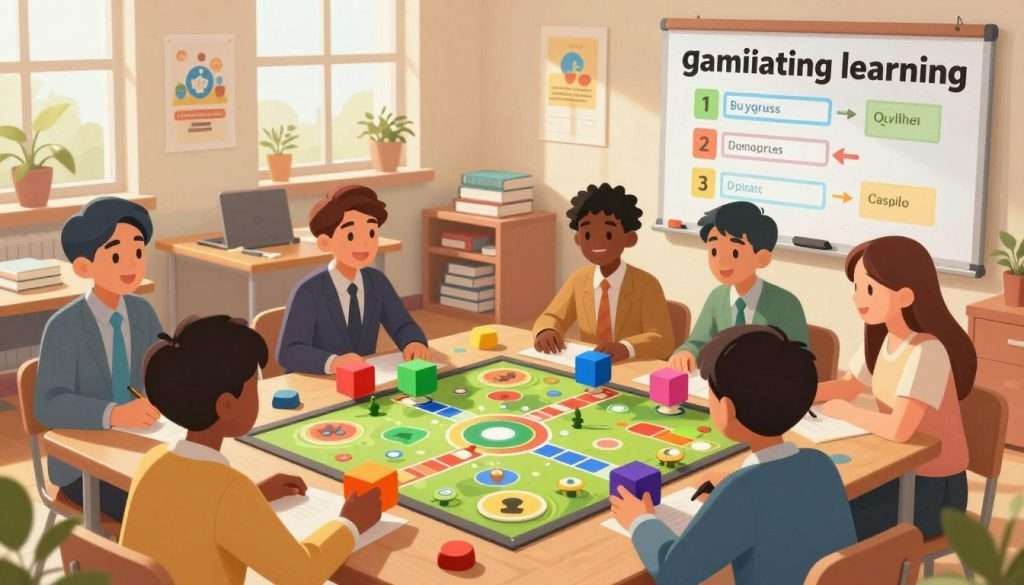
Have you ever felt like schoolwork is just endless chores? We think there’s a better way to handle it. By seeing education as progress, goals, and small wins, we can change our mindset.
When we gamify your learning, we stop dreading it. Instead, we see each session as an adventure where feedback helps us get better. This doesn’t mean we take it lightly; it just makes starting easier.
Tools like StudyQuest turn boring documents or slides into interactive challenges. If this sounds good, we invite you to get our free book, How to Become the Smartest Student in the Classroom. It offers a system for memory and routines that stick. Learn more at this link.
Key Takeaways
- Shift perspective to see learning as a game.
- Focus on clear goals and immediate feedback loops.
- Use interactive tools to boost engagement with materials.
- Small wins build momentum for long-term success.
- Access proven memory techniques to improve retention.
Why Gamify Your Learning Instead of Relying on Willpower
Waiting for the perfect mood to study is a trap. Many students get stuck in procrastination. They think they need a lot of willpower to tackle tough chapters.
Relying on sheer grit is exhausting and hard to keep up with for a whole semester.
When you gamify your learning, you stop waiting for inspiration. You create a system that moves you forward. By making study sessions into challenges, you turn work into fun.
How Game Mechanics Make Progress Visible
Seeing progress in school can be hard. You might read and highlight, but it’s hard to see your growth. Study gamification changes this by making goals clear and visible.
By setting rules and tracking your progress, you turn information into quests. Seeing your progress on charts or checklists makes studying feel like a game you want to play.
Why Immediate Feedback Strengthens Study Motivation
Traditional studying often leaves you unsure of your performance until exams. This lack of clarity hurts study motivation strategies. You need to know where you stand to stay motivated.
Tools like Kahoot, Poll Everywhere, and TopHat give instant feedback. They show you what you know and where to improve. This feedback makes every practice session a mission to win.
Using Rewards Without Losing Sight of Real Learning
It’s easy to focus on points and badges, but remember, they’re tools. The goal is to learn, not just collect rewards. Use rewards to support your habits, not replace the joy of learning.
If you want to learn more, check out my free book How to Become the Smartest Student in the Classroom. It has tips on memory and routines that work. Get your free copy here → https://www.studyingmachine.com/free-books/.
Gamify Your Learning: Turn Studying Into a Game You Want to Play
Ever wonder why you can play video games for hours but can’t focus on a book for twenty minutes? Games are designed to keep you interested. By gamify your learning, you can use that same drive to make studying exciting.
Seeing learning as a game changes everything. You stop seeing homework as a chore. Instead, it becomes a challenge to conquer. This mindset helps you stay on track, even when it’s hard.
Define the Knowledge, Skill, or Grade You Want to Improve
You need a clear goal to start. Without a target, you can’t win. Choose one area to focus on, like mastering organic chemistry or improving your essay writing.
- Identify the specific “boss” or hurdle you want to overcome.
- Set a measurable goal, like solving ten algebra problems in under fifteen minutes.
- Track your progress to see how far you have come.
Choose Game Elements That Match Your Learning Style
Everyone likes different games, and the same goes for studying. You might like the rush of a timer or the joy of leveling up. Turning studying into a game works best when you make it your own.
“The most effective way to learn is to treat every challenge as an opportunity to level up your own intelligence.”
Some students love stories, turning their studies into a journey. Others enjoy friendly competition or earning badges. My free book How to Become the Smartest Student in the Classroom offers strategies to help. No cost, no catch. Get your free copy here.
Build a Study Game Around Practice Rather Than Passive Review
Passive reading quickly loses interest. To succeed, focus on active practice. Platforms like StudyQuest show students study 40% faster with turning studying into a game by solving problems, not just reading notes.
Active engagement leads to better grades. Use AI plans, schedules, or quizzes to keep your brain active. When you gamify your learning, your study space becomes a place of discovery, not dread.
Turn Your Syllabus Into a Clear Learning Map
Your syllabus can be more than just a list of deadlines. It can be your guide to success. Use fun learning techniques to track your progress. View your course as a journey, with each assignment leading you closer to your goal.
Break Large Classes Into Manageable Learning Zones
Think of your class as a big game world. Divide it into smaller areas like lecture halls and reading libraries. This makes studying feel more natural and less like a chore.
By organizing tasks by zone, you see your work as smaller, focused areas. This keeps your mind fresh and prevents burnout from looking at a huge to-do list.
Convert Chapters and Assignments Into Specific Quests
Every chapter in your textbook is like a treasure chest waiting to be opened. Turn your reading assignments into quests. This gives you a clear goal for each study session.
Set small, achievable goals for each chapter. For example, aim to summarize three key concepts or solve five practice problems. Achieving these goals lets you move on to the next level of your journey.
Mark Prerequisites So Difficult Topics Become Unlockable Levels
Some topics need preparation before tackling them. Identify prerequisites as locked levels in a game. Master the basics before moving on to more complex topics.
This approach builds confidence. You’re never ready for a challenge you’re not prepared for. You learn skills in order, making your path to mastery steady and logical. For more on this, check out my free book How to Become the Smartest Student in the Classroom here.
| Feature | Traditional Study | Gamified Map |
|---|---|---|
| Syllabus View | List of chores | Interactive game map |
| Course Content | Overwhelming mountain | Manageable zones |
| Assignments | Stressful deadlines | Exciting quests |
| Difficult Topics | Roadblocks | Unlockable levels |
Create a Point System That Rewards Effective Study Behaviors
Imagine making your study sessions as fun as leveling up in your favorite game. Study gamification turns your study time into a game where every effort gets you closer to your goals. It makes your study desk feel like a playground.
Assign Points to Active Recall, Practice, and Problem Solving
Give the most points to active recall and solving tough problems. These activities are the most important for your brain. They should get the biggest rewards.
Don’t give points for just reading notes or highlighting. Focus on engaging study practices that challenge your brain. Struggling to remember information helps build stronger brain connections.
Reward Consistency Without Encouraging Busywork
Being consistent is key to doing well in school. You want a system that encourages daily study, even if it’s just for a little while. But, make sure it’s not just for busywork.
“The goal of a game is to keep you playing, but the goal of studying is to keep you growing. Make sure your points reflect growth, not just time spent.”
Tools like Habitica or Forest help keep you on track. They gently remind you to study without making you feel bad if you miss a day. Use them to stay motivated, not stressed.
Use Bonus Points for Reviewing Mistakes and Explaining Concepts
Learning by teaching others or explaining things to yourself is very effective. If you can explain a hard topic out loud, you really understand it. Give yourself bonus points for these moments of clarity.
Don’t be afraid of mistakes. See them as challenges to overcome. Reviewing wrong answers helps you learn more than getting things right the first time.
Example Point Values for a Typical Study Session
| Study Activity | Point Value | Difficulty Level |
|---|---|---|
| Warm-up Quiz | 10 Points | Easy |
| Focused Practice Problems | 25 Points | Medium |
| Reviewing Mistakes | 40 Points | Hard |
| Explaining Concept Aloud | 50 Points | Expert |
If this article inspired you, check out my free book How to Become the Smartest Student in the Classroom. It has memory techniques, study routines, and strategies that really work. No cost, no catch. Get your free copy here.
Design Quests, Challenges, and Study Missions
Think of your textbook as a map and your study session as a quest waiting to be conquered. By turning studying into a game, you shift your focus from the dread of a heavy workload to the excitement of hitting a specific target. This approach helps you stay engaged even when the material feels dense or overwhelming.
Write Daily Missions With One Clear Learning Outcome
Every great game has clear objectives, and your study routine should be no different. Instead of saying you will “study biology,” define a specific mission like explaining the process of mitosis or solving five complex physics problems. When you have a single, measurable outcome, you know exactly when you have won the round.
This clarity is one of the most effective study motivation strategies available. It prevents you from aimlessly flipping through pages and ensures that every minute spent at your desk contributes to your progress.
Use Time-Limited Challenges to Start Difficult Work
Starting is often the hardest part of any task. You can lower the emotional barrier by setting a timer for a short, intense burst of work. Think of this as a “speed run” where you try to complete a specific set of notes or practice questions before the clock hits zero.
These time-limited challenges provide a clear finish line that makes the work feel manageable. When you know you only have to focus for twenty minutes, it is much easier to dive in without hesitation.
Create Boss Battles for Tests, Essays, and Presentations
Major academic hurdles like final exams or big essays are your “Boss Battles.” These events require you to combine everything you have learned into one high-stakes performance. To prepare, you should simulate the pressure of the real event by mixing different types of questions and limiting your access to notes.
How to Make a Boss Battle More Difficult Than Ordinary Practice
To truly level up, you need to push your limits beyond standard review. You can incorporate educational games elements by using randomization, secret codes, or even timed simulations that mimic the actual test environment. By adding these constraints, you force your brain to retrieve information under pressure, which is exactly what you need for success.
| Feature | Standard Study | Gamified Study |
|---|---|---|
| Goal Setting | Vague “Review” | Specific “Mission” |
| Pacing | Open-ended | Time-limited |
| Feedback | Delayed | Instant |
| Difficulty | Static | Boss Battles |
If this article resonated with you, my free book How to Become the Smartest Student in the Classroom gives you a full system—memory techniques, study routines, and study motivation strategies that actually stick. No cost, no catch. Grab your free copy here → https://www.studyingmachine.com/free-books/.
By integrating these educational games concepts, you will find that turning studying into a game makes the entire process feel more active and rewarding. Keep experimenting with your rules until you find the perfect balance for your unique learning style.
Use Levels and Difficulty Tiers to Build Confidence
Think of studying as a video game where you unlock new levels as you learn. By breaking your work into levels, you see a clear path to success. This makes learning feel like a game, boosting your confidence as you progress.
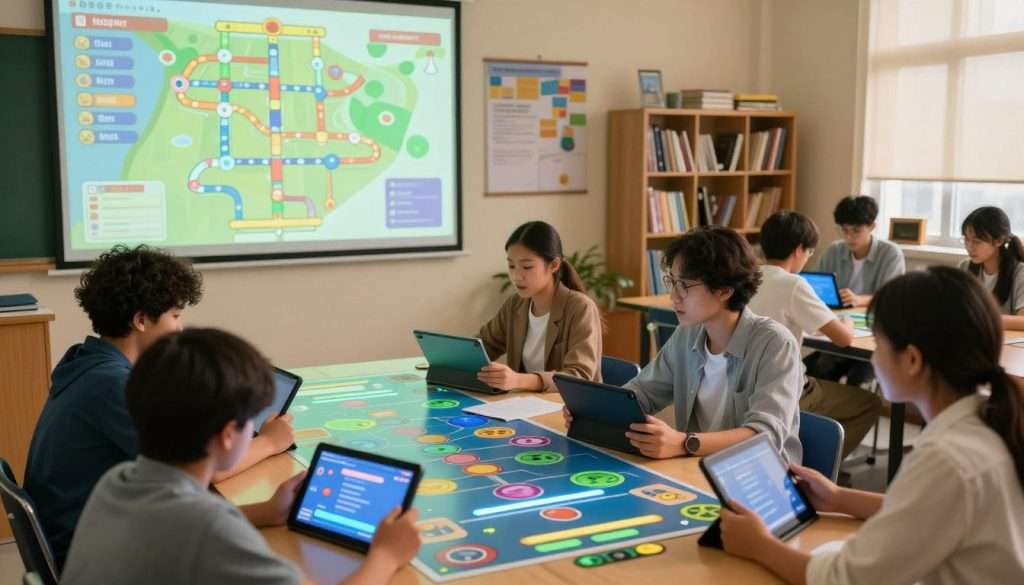
Start With Warm-Up Questions You Can Solve Independently
Every game starts with a tutorial to get you used to the controls. Start your study session with simple questions you can answer on your own. This helps you feel confident and ready for more.
Feeling a win right away boosts your brain’s confidence. This makes you more eager to take on tougher challenges later.
Progress From Recognition to Recall to Application
To really learn a subject, you need to go through different levels of difficulty. These interactive learning methods help you understand and apply what you learn, not just memorize it.
- Recognition: Spotting the right answer in a list or book.
- Recall: Remembering the answer without any help.
- Application: Using what you’ve learned to solve new problems or explain complex ideas.
Unlock Advanced Problems Only After Mastering the Basics
Think of your schoolwork like a locked map in a game. You wouldn’t face the final boss without leveling up first. Treat advanced problems as locked content that you can only access after mastering the basics.
Proving you’ve got the basics down before tackling harder stuff prevents frustration. If you want to dive deeper, my free book How to Become the Smartest Student in the Classroom offers strategies and techniques. No cost, no catch. Get your free copy here.
Turn Active Recall Into an Interactive Learning Game
Why stick to just reading when you can make learning fun? By changing your approach, you can turn hard study sessions into educational games. These games make studying exciting and keep you eager to learn more. Instead of racing against others, you aim to beat your own records.
Play Flashcard Battles Against Your Previous Score
Flashcards are great for boosting your memory and excitement. Turn each session into a timed battle against your past scores. If you got 15 cards right yesterday, aim for 16 today.
This approach makes studying feel like a challenge. You’ll focus better when you have a clear goal to achieve.
Use Retrieval Grids for Vocabulary, Facts, and Definitions
Retrieval grids are excellent interactive learning methods for complex info. Create a grid to match terms with their definitions or link concepts to examples. It turns facts into a puzzle to solve.
This method makes your brain work harder. The more you practice, the quicker you’ll connect ideas.
Build Question Ladders for Math, Science, and Reading Assignments
Question ladders help you grow from simple facts to complex problems. Start with basic definitions or math. As you climb, questions get tougher, testing your understanding.
How to Track Accuracy Without Guessing or Giving Partial Credit
To keep your game fair, use a clear scoring system. Avoid partial credit for almost correct answers. Record results as correct, incorrect, or skipped.
| Study Method | Traditional Approach | Gamified Approach |
|---|---|---|
| Flashcards | Passive review | Beat your high score |
| Vocabulary | Rote memorization | Retrieval grid puzzles |
| Problem Solving | Random practice | Question ladder levels |
If this article inspired you, check out my free book How to Become the Smartest Student in the Classroom. It offers memory techniques, study routines, and strategies that work. No cost, no catch. Get your free copy here → https://www.studyingmachine.com/free-books/.
Make Practice More Engaging With Educational Games
Staring at your notes until your eyes glaze over? It’s time for a change. Introduce some fun learning techniques into your study routine. Seeing your notes as a game can make studying feel less like a battle.
Use Spaced-Repetition Apps as a Daily Streak Challenge
Who doesn’t love a streak? Apps like Anki or Quizlet turn daily review into a game. The goal is to keep your streak going. Consistency is the secret weapon for memory, and these apps help you stay on track every day.
Turn Review Sessions Into Matching, Sorting, and Ranking Games
Instead of just reading, organize your notes physically. Make cards to match terms with definitions or sort events in order. Ranking concepts by importance or difficulty helps your brain actively process the material.
Adapt Board Games, Quizzes, and Simulations to School Subjects
Turn study topics into educational games for a fun night out. Create a crossword puzzle with course vocabulary or play Pictionary with scientific concepts. These activities help you visualize and explain ideas better than reading alone.
When Interactive Learning Methods Help—and When They Distract
Interactive learning methods are great for engagement, but be careful. Don’t let the game take over the lesson. The goal is to deepen your understanding, not create busywork.
If this article struck a chord, check out my free book How to Become the Smartest Student in the Classroom. It offers memory techniques, study routines, and strategies that work. No cost, no catch. Get your free copy here → https://www.studyingmachine.com/free-books/.
Build Feedback Loops That Show Exactly How You Are Improving
Imagine seeing your brain get sharper as you study. By tracking your performance, you turn effort into clear results. These study motivation strategies help you stay focused. You know you’re learning because you can see it.

Record Accuracy, Speed, Confidence, and Completion
To master your subjects, look at more than grades. Track your accuracy and how fast you solve problems. Also, rate your confidence level before and after each session.
Tracking how much you finish ensures you start and finish tasks. Seeing these numbers rise gives you a dopamine boost. This makes studying more engaging.
Analyze Wrong Answers as Clues for Your Next Mission
Don’t see wrong answers as failures. View them as clues to your knowledge gaps. Each mistake is a data point that shows where you need to improve.
Understanding why you missed a question helps you next time. This turns frustration into curiosity. You’re not failing; you’re gathering information to improve.
Use Progress Charts Without Comparing Yourself to Classmates
Your journey is unique, so keep your progress charts private. Comparing yourself to others can be stressful. Focus on beating your own records for motivation.
Seeing your growth on charts or graphs is undeniable. It makes you feel empowered to tackle tough topics. For more on these strategies, check out my free book How to Become the Smartest Student in the Classroom. Get your free copy here.
| Metric | What It Measures | Why It Matters |
|---|---|---|
| Accuracy | Percentage of correct answers | Confirms your current mastery |
| Speed | Time taken per problem | Builds fluency and efficiency |
| Confidence | Self-assessed certainty | Reduces test-day anxiety |
| Completion | Tasks finished vs. planned | Ensures consistent progress |
Add Social Competition Without Making Studying Stressful
Making your study time more fun can turn it into an exciting event. When you study with friends, it becomes more engaging. The goal is to build a supportive community, not a competitive one.
Challenge Friends to Friendly Review Rounds
Make studying fun by turning it into a game. Challenge a friend to answer quick questions. Keep it light by focusing on learning together, not who wins.
Use Team Goals for Study Groups and Class Projects
Focus on teamwork, not individual success. Set goals like solving a certain number of problems together. This builds camaraderie and makes studying easier.
Set Personal Leaderboards Based on Improvement
Don’t stress over test scores. Track your own progress, like how many times you’ve practiced. This way, you focus on getting better, not competing.
Want to learn more? My free book How to Become the Smartest Student in the Classroom offers tips on memory, study routines, and more. No cost, no catch. Get your free copy here → https://www.studyingmachine.com/free-books/.
Keep Your Study Game Fun, Sustainable, and Honest
Keeping your study gamification system healthy means focusing on learning, not just winning. It’s exciting to see your progress, but mastering the material is the real goal. If you’re rushing to earn badges, it’s time to rethink your approach.
Prevent Streaks, Points, and Rewards From Becoming the Main Goal
Apps like Habitica or Forest are great for building habits. But they can sometimes add too much pressure. If you’re stressed about losing a streak, the game has become a source of stress, not growth. Remember, your education is the priority, not the digital avatar on your screen.
Focus on the quality of your study sessions, not just the points you earn. If you’re turning studying into a game, make sure the rewards help you understand deeply. A high score means nothing if you can’t explain the concepts during an exam.
Adjust the Rules When a Strategy Stops Working
Not every game mechanic works for every subject. If a point system feels like a chore, change the rules. You’re the designer of your learning experience, so keep tweaking until it feels natural.
If you’re avoiding tough topics to keep your “easy” streak alive, adjust your point values. Give more points to the subjects that challenge you the most. This encourages you to tackle hard work, not just busywork.
Recover From Missed Study Days Without Quitting the Game
Life happens, and you’ll miss a study day sometimes. Don’t see it as a total failure. Avoid the all-or-nothing trap by creating “recovery missions” to get back on track without feeling overwhelmed.
A simple restart mission could be as small as reviewing one page of notes or solving two practice problems. This keeps the momentum alive. Consistency is about showing up over time, not being perfect every day.
Signs That Your Gamification System Needs a Reset
Stay honest with yourself about how your system is working. If you see these warning signs, your current setup might be harming more than helping:
| Warning Sign | Impact on Learning | Recommended Action |
|---|---|---|
| Chasing points over content | Lowers retention | Increase value of deep work |
| Anxiety over missed streaks | Increases burnout | Remove streak counters |
| Avoiding difficult topics | Creates knowledge gaps | Assign higher rewards to hard tasks |
| Remembering less despite high scores | False sense of progress | Switch to active recall testing |
If you want to dive deeper into these strategies, my free book How to Become the Smartest Student in the Classroom offers a full system. It covers memory techniques, study routines, and strategies that stick. There’s no cost and no catch, so grab your free copy here → https://www.studyingmachine.com/free-books/.
Conclusion
You now have the power to turn your daily tasks into exciting adventures. By setting a goal, planning your study schedule, and making learning fun, you change how you learn. You don’t need fancy software to make studying a game. Just a notebook, a timer, and simple rules can help a lot.
For a quick solution, StudyQuest is a great choice. It has challenges that adapt to you, instant feedback, and daily streaks to keep you going. Whether you use digital tools or old-school methods, the aim is the same. You want to make learning fun and meaningful.
Begin by picking one fun learning trick this week. See how your motivation grows when you track your progress like a game. Learning as a game makes hard work feel like a natural part of your day.
Ready for more? My free book, How to Become the Smartest Student in the Classroom, offers a complete system. It includes memory tips, study routines, and strategies that really work. There’s no cost and no catch. Get your free copy here: https://www.studyingmachine.com/free-books/.