

Ever feel like your lecture notes are just a messy pile of words that make zero sense later? You are not alone. We all have those days where we scramble to keep up with a fast-talking professor. Finding the best note-taking methods (cornell, outlining, mapping) compared is your first step toward turning that chaos into clarity.
Think of your study habits like a toolbox. You wouldn’t use a hammer to turn a screw, right? Different subjects need unique best note-taking techniques to help information stick. While typing is fast, handwriting your notes often boosts memory retention in ways a laptop simply cannot match.
In this guide, we will explore how to pick the right strategy for your specific learning style. If you want to master your study routine, my free book How to Become the Smartest Student in the Classroom offers a full system of memory hacks and strategies. You can grab your free copy here with no strings attached.
Key Takeaways
- Handwriting notes significantly improves long-term memory retention compared to typing.
- Different subjects demand specific note-taking methods to maximize your efficiency.
- The Cornell system is ideal for organizing complex lecture information quickly.
- Outlining helps you create a clear hierarchy of concepts for easier review.
- Mapping is a powerful visual tool for connecting related ideas and themes.
Why the Best Note-Taking Method Depends on the Learning Situation
Finding the right way to capture information is less about following a rulebook and more about reading the room. You might have noticed that the note-taking methods that worked for your history lecture fall flat during a fast-paced math class. That is perfectly normal because your approach should shift based on the environment.
If this article resonates with you, my free book How to Become the Smartest Student in the Classroom gives you a full system—memory techniques, study routines, and strategies that actually stick. No cost, no catch. Grab your free copy here.
How lecture speed, subject structure, and learning goals affect note-taking
When you walk into a classroom, the speed of the lecture dictates how much you can write. If a professor speaks at lightning speed, you need a system that prioritizes brevity over beauty. On the other hand, a slow, structured lecture allows you to build complex hierarchies of information.
Your learning goals also play a massive role in choosing the best note-taking techniques. Are you trying to memorize definitions for a quiz, or are you mapping out how different concepts connect for a final essay? Matching your strategy to the specific goal ensures you spend your energy on the right tasks.
Active processing versus copying information word for word
Many students fall into the trap of transcribing every word the instructor says. This is a passive activity that keeps your hands busy but leaves your brain mostly idle. True learning happens when you engage in active processing, which means you translate ideas into your own words.
When you force your brain to summarize, categorize, or visualize information, you are actually studying while you write. This shift turns a boring chore into a powerful thinking exercise. It is the difference between simply having a transcript and having a roadmap for your future study sessions.
What to compare: organization, recall, review time, flexibility, and effort
To effectively compare note-taking methods, you need to look at how they handle the demands of your schedule. Some note-taking styles are great for quick review, while others excel at showing the big picture. Use the table below to see how these factors stack up against each other.
| Criteria | Cornell | Outlining | Mapping |
|---|---|---|---|
| Organization | High | Very High | Moderate |
| Recall Support | Excellent | Moderate | High |
| Review Time | Fast | Moderate | Slow |
| Flexibility | Moderate | High | Very High |
| Effort Required | Moderate | Low | High |
The Best Note-Taking Methods (Cornell, Outlining, Mapping) Compared
Ever felt lost in a sea of notes? You’re not alone. Many students struggle to stay organized during lectures.
Let’s look at the Cornell method, the outlining method, and the mapping method. Each method has its own way to help you process information, whether in history or science.
Quick comparison of the Cornell, outlining, and mapping methods
Organization and visual structure
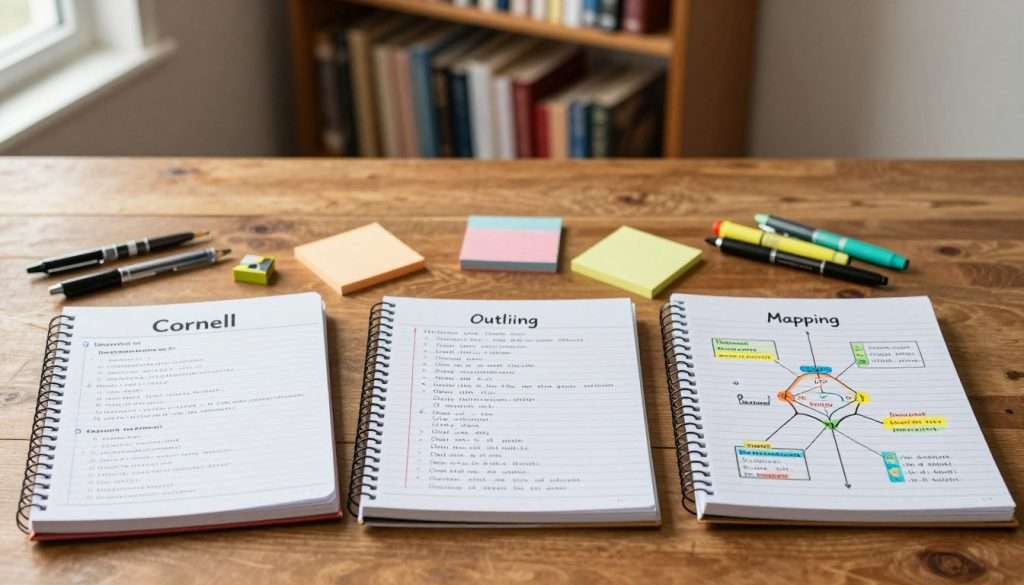
The Cornell method uses a layout with a cue column and summary section. The outlining method has a hierarchical structure of main and sub-points. The mapping method uses a visual web of ideas.
Memory and recall support
The Cornell method boosts memory with questions and summaries. Outlining shows concept relationships. Mapping is best for visual learners to see complex topics.
Speed during lectures and reading
For fast lectures, outlining is quick. Mapping is good for brainstorming. Cornell method takes more setup but helps during study time.
Ease of review before an exam
For studying, a good note-taking comparison is key. Cornell notes are for self-testing. Outlines provide a roadmap. Maps are a visual summary to refresh your memory.
Which method works best for different classes and students
Choosing the right method depends on your class. For math, an outline might be best. For literature or history, Cornell is effective.
If this article helped, check out my free book How to Become the Smartest Student in the Classroom. It has memory techniques, study routines, and strategies. No cost, no catch. Get your free copy here.
How the Cornell Method Organizes Notes for Active Review
The Cornell method makes your lecture notes useful for remembering information. It divides your page into three parts. This helps your brain understand the information better than just writing it down.
The cue column, note-taking area, and summary section
Your page layout is simple but effective. The right side is for taking notes during class. The left side is for keywords and questions. The bottom is for your summary.
How to use Cornell notes during a lecture or textbook reading
In class, focus on the main ideas in the note-taking area. Don’t write every word. Instead, summarize what the teacher says in your own words.
Why writing questions improves retrieval practice
Writing questions in the cue column is a top effective note-taking strategy. It turns your notes into a study guide. When you answer questions, it strengthens your memory.
How to review Cornell notes with covering, reciting, and checking
To review, cover the main area with paper. Look at the questions and try to answer them out loud. Then, uncover the notes to check your answers.
Turning headings and key terms into self-test questions
Stuck? Use your headings as questions. For example, “What are the three main causes of this event?” This makes studying more productive.
Writing an accurate summary without copying the page
The summary section is for condensing complex ideas. Write a few sentences that capture the main idea. This helps you understand complex information better.
Strengths and limitations of the Cornell method
This system is great for organizing notes but not for everyone. Here’s how it works in different subjects.
| Subject Type | Effectiveness | Primary Benefit |
|---|---|---|
| History & Psychology | High | Excellent for conceptual recall |
| Biology | High | Great for defining key terms |
| Mathematics | Low | Hard to fit formulas in columns |
Best uses for history, biology, psychology, and lecture-heavy courses
The Cornell method is best for courses that need lots of memorization. It helps a lot with understanding complex ideas in lectures.
Challenges for mathematical problem-solving and highly visual content
Math and visual subjects might find the Cornell layout too tight. They need more space for solving problems and drawing.
If you liked this article, check out my free book How to Become the Smartest Student in the Classroom. It has memory techniques, study routines, and strategies that work. No cost, no catch. Get your free copy here → https://www.studyingmachine.com/free-books/.
How the Outlining Method Builds a Clear Hierarchy of Ideas
The outlining method is like building a sturdy skeleton for your brain to hang information on. Instead of writing long, rambling sentences, you focus on the core structure of the lecture or text.
Using main ideas, supporting points, and details
You start by placing the most important topic at the far left of your page. As you move deeper into the subject, you add supporting points underneath, slightly indented to the right. Then, you tuck specific details or examples under those points.
This logical flow keeps your notes clean and easy to scan. By stripping away the fluff, you get straight to the heart of what matters most.
How indentation shows relationships between concepts
Think of indentation as a visual staircase that guides your eyes down the page. Each level of indentation represents a deeper layer of understanding.
When you look back at your notes, this structure makes it incredibly easy to see how a minor detail connects back to the main idea. It turns a wall of text into a clear, hierarchical map of the lesson.
Creating an outline when the instructor follows a clear sequence
This style shines when your professor follows a logical path, like moving from a broad theory to specific case studies. Because the outlining method relies on a predictable structure, you can easily slot new information into the right place as it comes up.
Strengths and limitations of the outlining method
While this approach is fantastic for keeping things tidy, it isn’t perfect for every situation. You need to weigh the pros and cons before deciding if it fits your current class.
Benefits for structured subjects and organized textbooks
If you are studying subjects like history or business, this method is a total game-changer. It excels at capturing organized information from textbooks where the hierarchy is already laid out for you.
Risks of missing information when the speaker moves quickly
The biggest downside happens when a speaker jumps around or talks at lightning speed. Because you are busy formatting your indentations, you might struggle to keep up if the lecture lacks a clear, linear path.
Improving outline notes with keywords, questions, and examples
To get the most out of your notes, don’t just copy facts. Try adding your own questions in the margins or using bold keywords to make key terms pop.
If this article resonated with you, my free book How to Become the Smartest Student in the Classroom gives you a full system — memory techniques, study routines, and strategies that actually stick. No cost, no catch. Grab your free copy here.
How the Mapping Method Shows Connections Between Concepts
Sometimes, the best way to capture complex ideas is to stop writing sentences and start drawing connections. Many note-taking styles stick to rigid structures. But mapping offers a creative, visual alternative that lets your brain work naturally.
Starting with a central concept and branching into related ideas
You start by placing your main topic in the center of your page. Then, you draw branches outward to represent sub-topics, key definitions, or supporting examples.
This organic flow helps you see how different pieces of information relate. It turns a flat page into a dynamic web of knowledge.
Using arrows, labels, colors, and spatial grouping effectively
Don’t be afraid to get colorful! Using different markers or highlighters for specific categories helps your brain categorize information instantly.
Arrows are perfect for showing cause-and-effect relationships between two distant points on your map. By grouping related ideas together, you create a visual shorthand that is much faster to scan than a wall of text.
How mapping supports big-picture understanding and memory
Because you are not stuck in a linear format, you can easily see the “big picture” of a subject. This helps you understand how a tiny detail fits into the larger framework of the course.
“The brain remembers images and spatial relationships far better than it remembers long, repetitive lists of words.”
Strengths and limitations of the mapping method
The mapping method is incredibly flexible, but it isn’t always the right tool for every situation. Understanding when to use it is key to mastering your study routine.
Best uses for science systems, processes, and cause-and-effect relationships
This style shines when you are studying complex systems like the human circulatory system or historical cause-and-effect chains. It allows you to visualize the flow of information rather than just memorizing definitions.
Challenges when information is linear, detailed, or presented rapidly
If your professor speaks at lightning speed or presents information in a strictly sequential, detail-heavy format, you might struggle to keep up. In these cases, trying to map every single word can lead to a messy, confusing page that is hard to review later.
Turning a completed concept map into a study guide
Once you have finished your map, you have a powerful visual summary ready for exam prep. You can cover one branch at a time and try to recall the details connected to it, which is a fantastic way to test your memory.
If this article resonated with you, my free book How to Become the Smartest Student in the Classroom gives you a full system — memory techniques, study routines, and strategies that actually stick. No cost, no catch. Grab your free copy here.
Comparing the Cornell, Outlining, and Mapping Methods by Key Criteria
Let’s look at how different note-taking styles compare in real life. When you compare note-taking methods, you see that no one system works for everyone. The best method depends on your class goals.
Which method is fastest during a live lecture
If your professor talks fast, the outlining method is great. It lets you write down main points and sub-points easily. You don’t have to worry about complicated layouts.
Which method creates the most efficient review material
The Cornell method is best for study notes. It divides your page into cues, notes, and a summary. This makes your notes easy to review and study.
Which method best supports memorization and retrieval practice
The Cornell method helps with active recall. It lets you cover your notes and quiz yourself. This makes learning easier than just reading your notes again.
Which method handles complex relationships and visual information
The mapping method is best for complex ideas. It lets you draw connections between concepts. Visual learners find this way more intuitive than lists.
Which method requires the least preparation and formatting
The outlining method needs almost no setup. You can start writing right away. The other methods need some preparation to work well.
“The secret of getting ahead is getting started. Choose a system that feels natural to you, and you will find that studying becomes a much lighter load.”
Side-by-side comparison table for the three note-taking styles
| Method | Best For | Speed | Review Efficiency |
|---|---|---|---|
| Cornell | Self-testing | Medium | High |
| Outlining | Linear lectures | High | Medium |
| Mapping | Complex ideas | Medium | High |
If this article helped you, check out my free book How to Become the Smartest Student in the Classroom. It has memory techniques, study routines, and strategies that work. No cost, no catch. Get your free copy here → https://www.studyingmachine.com/free-books/.
Choosing the Right Note-Taking Method for Each Class and Task
Finding the right way to take notes is like picking the right tool for a job. You wouldn’t use a hammer for screws, and you shouldn’t use one note-taking style for all subjects. By choosing the right note-taking methods for each class, you can make learning more effective.
Use Cornell notes for lectures that require recall and self-testing
The Cornell system is great for classes that focus on memorization. It helps you focus on the most important ideas and turn them into questions. This active recall helps move information from short-term to long-term memory.
Use outlines for sequential explanations, readings, and hierarchical content
Outlining is best for subjects that follow a logical order. It’s perfect for classes that go through a textbook chapter or a timeline. This style keeps your notes organized and easy to review.
Use maps for connected ideas, systems, and conceptual relationships
Information isn’t always linear. For complex systems, like biology or economics, mapping is a top choice. It lets you see how different parts of a system work together.
Match the method to mathematics, literature, history, science, and business courses
Different subjects need different approaches. Here’s how to adapt your note-taking styles for each class:
- Mathematics: Use a split-page layout for formulas and problem-solving.
- Literature: Map themes, character arcs, and symbols in a novel.
- History: Outlining is great for tracking cause-and-effect over time.
- Science: Cornell notes are good for defining terms and testing yourself.
- Business: Mix mapping for strategy and outlining for case studies.
When combining methods produces better notes than choosing only one
You don’t have to stick to one method all semester. The best students mix and match to get the best results. One page can do many jobs, so feel free to experiment.
Outlining during class and summarizing with Cornell review prompts
Start with an outline during lectures to capture the flow of information. Then, use Cornell prompts for a summary. This hybrid approach combines structure with testing power.
Mapping a chapter after taking detailed linear notes
For confusing chapters, start with linear notes. Then, create a concept map to visualize connections. This step helps solidify your understanding.
If this article helped you, check out my free book How to Become the Smartest Student in the Classroom. It offers memory techniques, study routines, and strategies that work. No cost, no catch. Get your free copy here → https://www.studyingmachine.com/free-books/.
Effective Note-Taking Strategies That Improve Any Method
Boost your favorite note-taking styles with simple habits. These effective note-taking strategies save time and improve understanding.

Listen for ideas instead of transcribing every sentence
Don’t try to write down every word. Focus on core concepts and their logic. Writing verbatim means you’re not thinking about the material.
Use abbreviations, keywords, and precise examples without sacrificing meaning
Create your own shorthand to keep up with lectures. Symbols like “&” for “and” save time. Keep notes lean and mean with key words that trigger memory.
Separate important concepts from supporting details
Not all sentences are equal. Use indentation or bullet points for main arguments and evidence. This makes your notes easy to scan.
“Learning is not a spectator sport. You must be an active participant in the process of capturing and organizing your own knowledge.”
Review and refine notes soon after class
Review your notes immediately after class. This helps solidify information. A few minutes of effort prevents forgetting.
Test yourself instead of relying on rereading
Rereading notes can be passive. Try explaining concepts out loud. If you can teach it, you know it.
| Habit | Benefit | Impact |
|---|---|---|
| Active Listening | Better comprehension | High |
| Shorthand | Increased speed | Medium |
| Self-Testing | Stronger retention | Very High |
Want to go deeper? Get the free book How to Become the Smartest Student in the Classroom
If you liked this article, check out How to Become the Smartest Student in the Classroom. It’s a full system for academic success.
Memory techniques, study routines, and strategies that actually stick
We offer a roadmap for success. There’s no cost and no catch, just valuable help to excel.
Free copy with no cost and no catch: https://www.studyingmachine.com/free-books/
Get your free copy here and start learning better today!
Conclusion
You now have a clear roadmap to transform how you capture information. By comparing the best note-taking methods, you can choose the right one for every lecture or chapter. This way, you can pick the best tool for each task.
Cornell notes are great for active review. Outlining helps organize complex ideas. Mapping is perfect for showing connections between big ideas. Your success depends on choosing the right method for the subject.
Try one method in your next class to see how it feels. As you go, refine your approach. Watch your study sessions become more manageable and effective. You deserve a system that makes learning easy.
If you want to improve even more, my free book How to Become the Smartest Student in the Classroom is waiting for you. It covers memory techniques and study routines that stick. Get your free copy here at https://www.studyingmachine.com/free-books/ to start leveling up your academic game today.