
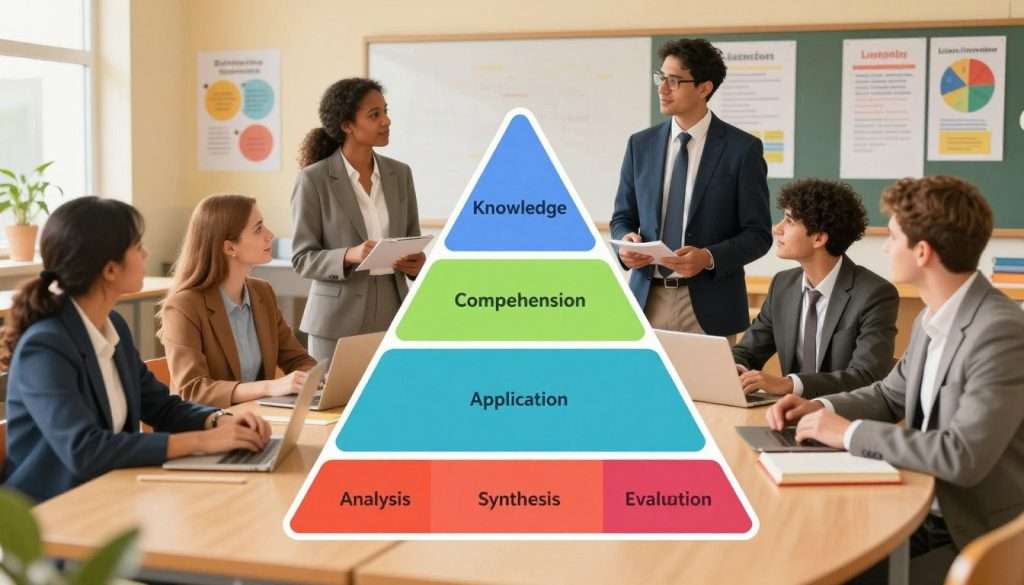
Have your study sessions ever felt like wandering through a thick, gray fog? Many of us stare at notes without a clear path forward. This is where bloom taxonomy becomes a powerful study tool.
Think of this framework as a practical map for your brain. It shows what you know and, more importantly, what you can do with that information. Originally designed to clarify educational goals, it now helps plan lessons, assignments, and personal study habits.
This system breaks learning into six distinct cognitive levels, turning a mountain of work into a clear, climbable trail. Teachers can use it when building a curriculum, and students can use it when preparing for finals. Using bloom taxonomy makes the process feel less like a chore and more like a rewarding journey toward mastery.
Key Takeaways
- Provides a structured map to track your learning progress.
- Helps you move beyond simple memorization to deep understanding.
- Simplifies the process of planning effective study sessions.
- Offers a clear guide for teachers to design better assessments.
- Transforms overwhelming tasks into manageable cognitive steps.
Bloom Taxonomy: Purpose, Origins, and Educational Value
School may seem like a random list of tasks, but a smart system guides how students learn and grow.
This system helps teachers understand learning and plan lessons with clear goals.
In the 1950s, Benjamin Bloom and his colleagues saw that teachers needed better ways to discuss student progress. They created a shared language for designing tests and organizing teaching goals, leading to the bloom taxonomy cognitive domain.
Why Benjamin Bloom and His Colleagues Created the Framework
The team noticed that most exams tested simple recall. They wanted a structure that included different levels of mental effort.
This framework helped teachers move beyond memory tests. It became a flexible roadmap for separating thinking skills from physical and emotional development.
How Bloom’s Taxonomy Supports Clear Learning Goals
A goal such as “understand more about history” is too vague to guide learning. Clear goals show students what they must do.
Using bloom’s taxonomy educational objectives helps teachers replace vague goals with clear, observable actions. Instead of “understanding,” students might “compare” or “critique” a historical event.
Clear objectives show you exactly what your teacher expects. They also help you take control of your own study process with confidence.
The Difference Between Memorizing Information and Demonstrating Learning
Memorization is the starting point, not the finish line. Facts build a foundation, but mastery means using information in new ways.
The bloom’s taxonomy educational objectives approach moves you beyond rote memorization. It asks you to apply, analyze, and create, making reading active, meaningful learning.
These higher-level skills help you do more than collect facts. They build a deeper, lasting understanding of the world around you.
Bloom’s Taxonomy Levels and the Cognitive Learning Hierarchy
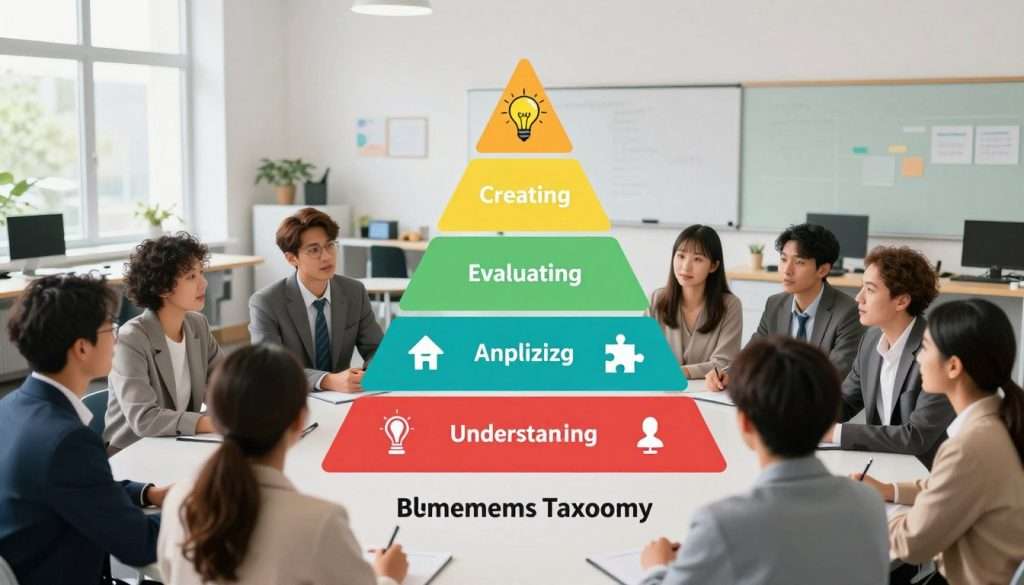
Think of learning as a staircase. Each step builds on the one before it. A strong base supports the bloom’s taxonomy hierarchy. It guides you from simple recall to complex, creative thinking.
We often begin by memorizing facts, but that is only the first step. As you move through these bloom’s taxonomy levels, you learn to use information in many ways. Here is how this process can appear in daily life.
Remember: Retrieving Facts, Terms, and Basic Information
This level forms the foundation of learning. It means retrieving information from memory, such as a biology term or historical date. This base helps you handle more complex tasks.
Understand: Explaining Ideas in Your Own Words
After learning facts, you must understand their meaning. This level involves interpreting information. If you explain a concept to a friend without textbook words, you have reached it.
Apply: Using Knowledge in Familiar and New Situations
Next, you put knowledge to work. Applying means using what you learned to solve a problem or complete a task. For example, you might use a new math formula to calculate your monthly budget.
Analyze: Examining Parts, Patterns, and Relationships
At this stage, you break material into smaller parts to see how they connect. You look for patterns or links that may not seem clear at first. It is like taking apart a clock to see how its gears make it tick.
Evaluate: Making Judgments Based on Evidence and Criteria
Here, you step back and make a judgment. You are not only learning; you are critiquing. You weigh evidence, check for bias, and decide whether a solution works based on clear standards.
Create: Producing an Original Solution, Product, or Argument
This is the hierarchy’s peak. You combine what you learned to build something new. You might write an essay, design a project, or invent a new way to study. Now, you are the creator.
| Level | Focus | Example Task |
|---|---|---|
| Remember | Recall | Listing parts of a cell |
| Understand | Meaning | Summarizing a chapter |
| Apply | Usage | Solving a word problem |
| Analyze | Structure | Comparing two theories |
| Evaluate | Judgment | Debating a policy |
| Create | Innovation | Designing a new experiment |
The Revised Bloom’s Taxonomy and Its Two Dimensions
Why did the classic learning hierarchy receive a major makeover in 2001? The original framework helped teachers, but modern classrooms needed a more active model. Experts revised it to better show how people learn today.
How the 2001 Revision Changed the Original Hierarchy
The biggest change replaced nouns like “knowledge” and “comprehension.” The update uses active verbs to describe what your brain does. This shift made the bloom taxonomy a more dynamic tool for students and teachers.
By focusing on actions, the framework helps you lead your own learning. It is not just about storing information; it is about doing something meaningful with it.
Why the Levels Use Action Verbs Instead of Nouns
Verbs like “remembering” and “creating” make the bloom’s taxonomy hierarchy feel more personal. Nouns can seem like labels, but verbs invite you to act. An objective that says “create” tells you to build or design something new.
This change helps you track progress more clearly. You can tell whether you are recalling a definition or applying a concept to a real-world problem.
The Cognitive Process Dimension
The bloom taxonomy cognitive domain forms the first part of this two-dimensional model. It explains how you learn. It maps mental steps from basic recall to complex creation.
The Knowledge Dimension
The second dimension focuses on what you learn. It groups the information you use and helps you understand your study material’s depth.
Factual Knowledge
This includes basic terminology and specific details you need to know. These building blocks include history dates and vocabulary words from language class.
Conceptual Knowledge
This level explores big ideas and theories. It shows how facts connect and helps you form a broader view of a topic.
Procedural Knowledge
Here, you learn how to complete tasks. This includes methods, techniques, and algorithms for solving problems.
Metacognitive Knowledge
This advanced level involves thinking about your own thinking. You recognize your learning habits, understand your strengths, and choose useful strategies.
How the Two Dimensions Work Together in Learning Objectives
Combining these dimensions creates a useful grid for planning study sessions. You can decide whether to remember a fact or analyze a complex procedure. This flexibility makes the bloom’s taxonomy hierarchy a helpful tool for any student.
| Dimension | Focus | Example |
|---|---|---|
| Cognitive Process | The action you perform | Analyzing a data set |
| Knowledge Type | The content you use | Conceptual theory |
| Combined Goal | The learning outcome | Explain a theory using data |
Bloom’s Taxonomy Verbs for Strong Learning Objectives
Think of learning objectives as a map, and precise verbs as your compass. Clear language turns a vague goal into a target you can reach and measure. Mastering bloom’s taxonomy verbs helps you move from passive reading to active, measurable growth.
Verbs for Remembering and Recognizing Information
Start with recall when you need to retrieve basic facts from memory. Use these verbs to show what you remember:
- Define
- List
- Identify
- Recall
- Name
Verbs for Explaining and Interpreting Meaning
After learning the facts, show that you grasp the concept. These verbs show that you are not repeating words; you are getting it:
- Summarize
- Classify
- Describe
- Explain
- Discuss
Verbs for Applying Methods and Procedures
Next, put your knowledge to work. Use these verbs to show that you can apply what you know in a new situation:
- Solve
- Demonstrate
- Implement
- Calculate
- Use
Verbs for Analyzing Evidence and Relationships
Analysis means breaking ideas apart to see how they work. Use these verbs when exploring the “why” and “how” of a topic:
- Compare
- Contrast
- Categorize
- Examine
- Distinguish
Verbs for Evaluating Claims and Solutions
At this stage, act like a judge. Study the evidence and decide whether it supports a claim:
- Critique
- Justify
- Evaluate
- Support
- Defend
Verbs for Creating Original Work
This is the highest level of the hierarchy. Use what you learned to build something new:
- Design
- Construct
- Formulate
- Develop
- Compose
Weak Verbs That Make Objectives Difficult to Measure
You may want to use words like “understand,” “learn,” or “appreciate.” These words sound useful, but they are invisible. You cannot see someone “understanding” something, so you cannot measure the goal.
Avoid blurry terms when tracking progress. Replace them with actions that someone can see or hear.
How to Pair an Action Verb With a Specific Learning Outcome
To write effective bloom’s taxonomy educational objectives, use this simple formula: Action Verb + Specific Task. This structure turns broad ideas into clear goals.
For example, instead of saying “I will learn about history,” try “I will compare two historical sources.” Instead of “I will understand the science process,” try “I will design a model that explains the water cycle.” These bloom’s taxonomy educational objectives keep your study time focused and productive.
Bloom’s Taxonomy Educational Objectives in Lesson Planning
Breaking broad teaching goals into small, measurable steps supports effective classroom management. With bloom’s taxonomy educational objectives, you can see clear evidence of student learning in real time.
Writing Objectives That Identify an Observable Student Performance
A strong objective is more than a wish; it provides a clear roadmap. Name the learner, the action, the content, and the expected performance level.
Instead of saying “students will learn about the Civil War,” try “students will compare two primary sources from the Civil War to identify conflicting perspectives.” Specific bloom’s taxonomy verbs make goals observable and easy to track.
Aligning Objectives With Instructional Activities
Alignment supports a successful lesson. If an objective asks students to analyze evidence, activities must include evidence analysis.
A common mistake is setting a high-level goal but assigning low-level busywork. To evaluate a scientific theory, students need more than a vocabulary quiz. Activities should provide the practice needed to reach that cognitive level.
Matching Assessments to the Intended Cognitive Level
Your assessment should reflect your objective. If students must “create” an original solution, the test or project must require something new.
The bloom taxonomy framework helps prevent mismatches between teaching and grading. For an application objective, ask students to apply a concept to an unfamiliar situation.
Turning a Broad Goal Into a Measurable Objective
Course goals are often broad, such as “understanding the scientific method.” Break them into smaller steps that show progress over time.
Example: Revising a History Learning Objective
Vague: “Students will know about the causes of the American Revolution.”
Revised: “Students will categorize the economic and social causes of the American Revolution using a graphic organizer.”
Example: Revising a Science Learning Objective
Vague: “Students will understand how photosynthesis works.”
Revised: “Students will diagram the process of photosynthesis and predict how changes in light intensity affect plant growth.”
| Vague Goal | Cognitive Level | Measurable Objective |
|---|---|---|
| Learn about fractions | Apply | Solve real-world word problems using fractions |
| Understand poetry | Analyze | Compare the themes of two different poems |
| Know the water cycle | Create | Design a model showing the water cycle stages |
| Study geography | Evaluate | Critique the impact of climate on local trade |
By applying these bloom’s taxonomy verbs, you transform teaching from a guessing game into a precise, rewarding experience. This approach benefits everyone involved. Remember, the bloom taxonomy is flexible, not a rigid ladder that limits creativity.
Bloom’s Taxonomy Questions for Classroom Discussion and Assessment
The right questions can turn a passive study session into an active brain workout. Using bloom’s taxonomy questions moves you beyond memorizing facts and into deeper learning. Like a ladder, they guide you from basic recall toward complex, original thought.

Choosing the right bloom’s taxonomy verbs shows your brain what kind of thinking to use. Whether you prepare for a quiz or lead a group discussion, these prompts support your bloom’s taxonomy educational objectives.
Remembering Questions That Check Foundational Knowledge
These questions provide a starting point. They ask you to recall specific facts, dates, or definitions. Use verbs like list, define, or identify to begin.
- What is the definition of…?
- Can you list the main components of…?
- Who were the key figures involved in…?
Understanding Questions That Reveal Comprehension
Once you know the facts, show that you understand them. These questions ask you to explain concepts in your own words. Look for verbs like summarize, describe, or interpret.
“If you can’t explain it simply, you don’t understand it well enough.” — Albert Einstein
Applying Questions That Connect Learning to Practice
Now, use what you know in a practical way. These questions connect theory with the real world. Use verbs like solve, demonstrate, or calculate to test your skills.
- How would you use this concept to solve a real-world problem?
- Can you demonstrate how this process works in a new situation?
Analyzing Questions That Encourage Evidence-Based Reasoning
This level breaks ideas into parts so you can see how they connect. Look for patterns, connections, and hidden meanings. Use verbs like compare, contrast, or examine.
Ask yourself: What evidence supports this claim? Examining an argument’s parts gives you a clearer view of the whole.
Evaluating Questions That Require Judgment and Justification
Here, you act as a critic. You must make a judgment based on specific criteria. Use verbs like justify, critique, or defend.
Ask: Is this solution effective, and why? Do not just state an opinion; support it with solid logic.
Creating Questions That Invite Original Thinking
This is the ladder’s highest level. You use your knowledge to build something new. Use verbs like design, propose, or construct.
Try asking: How could I design a better version of this? Creating something new helps you master the subject matter.
Using Bloom’s Taxonomy to Improve Studying and Note-Taking
Have you read the same page ten times without learning anything? This common trap ends when you change your approach. Use the bloom taxonomy to make study time active and engaging.
Moving Beyond Passive Reading and Highlighting
Highlighting can make your textbook colorful, but it rarely helps you remember the material. When you only highlight, your brain stays passive. Shift from consuming information to interacting with it.
Close your book after each paragraph. Ask what you read, then summarize it in your own words. This habit makes your brain work harder, helping information stay with you longer.
Creating Retrieval Questions at Different Taxonomy Levels
One strong way to master a subject is writing your own bloom’s taxonomy questions. Begin with simple recall questions, such as, “What is the definition of this term?” Then move up the ladder.
Ask yourself, “How would this concept work in a new case?” or “What evidence supports this specific claim?” These questions create a practice exam that tests your knowledge.
Turning Class Notes Into Application and Analysis Tasks
Do not just copy what your teacher says. Transform your notes into tasks that require you to apply or analyze the content. For a scientific process, draw a diagram showing what happens when one variable changes.
This turns static notes into a dynamic puzzle. You stop memorizing facts and learn how the pieces fit together. This is where real understanding happens.
Using Self-Explanation to Test Genuine Understanding
Knowing a page is not the same as teaching its ideas aloud. Use self-explanation as a metacognitive check to test your understanding. Pretend you are explaining the concept to a friend who has never heard it.
If you stumble or get stuck, review that specific part again. This humble method helps you find gaps in your knowledge.
Building a Study Session That Progresses From Recall to Creation
A great study session should feel like a climb. Recall basic facts first, then evaluate arguments and create your own solutions. This structure covers all the levels of the bloom taxonomy.
Sample Study Sequence for a Biology Chapter
- Remember: List the parts of a cell.
- Understand: Explain the function of each part.
- Apply: Predict what happens to a cell if the mitochondria fail.
- Analyze: Compare the cell to a factory system.
Sample Study Sequence for a Literature Unit
- Remember: Identify the main characters in the story.
- Understand: Summarize the central conflict.
- Evaluate: Judge whether the protagonist’s final decision was justified.
- Create: Write an alternative ending based on the character’s established traits.
These bloom’s taxonomy questions turn studying from a dreaded chore into a rewarding challenge. You will spend less time rereading and more time mastering the material.
Bloom’s Taxonomy Chart: How to Read and Use It Effectively
A bloom’s taxonomy chart is more than a colorful graphic. It maps how your brain approaches learning.
What a Bloom’s Taxonomy Chart Usually Displays
Most charts arrange the bloom’s taxonomy levels in a pyramid or circular flow. Basic skills appear at the bottom, followed by more complex thinking tasks.
- Levels: The stages of thinking, from basic recall to complex creation.
- Action Verbs: Specific words that describe what you are actually doing with the information.
- Knowledge Categories: The types of facts or concepts you are working with.
How the Levels Relate Without Becoming a Rigid Ladder
Many people think you must finish one level before starting the next. See the bloom’s taxonomy hierarchy as a toolkit, not a strict staircase.
“Learning is not a linear process; it is a messy, beautiful web of connections that grows as you challenge your own understanding.”
You might begin with analysis to test what you already know. If you get stuck, review a lower level before moving up again.
Choosing the Right Level for a Specific Learning Task
Not every assignment requires the pyramid’s highest level. For a vocabulary quiz, focusing on the “Remember” level works well.
For a research paper, aim for the higher bloom’s taxonomy levels. Match your study method to the assignment’s goal to save time and energy.
Why Higher-Level Thinking Still Depends on Foundational Knowledge
You cannot bake a cake without ingredients. Likewise, you cannot analyze ideas deeply without facts.
Foundational knowledge fuels critical thinking. When you master the basics, you gain space to solve complex problems. Never underestimate the power of a solid foundation; it helps you create original ideas with confidence.
Common Mistakes When Using Bloom’s Taxonomy Charts
One major mistake is thinking “higher” levels are always better. Sometimes, the key task is remembering an important definition accurately.
Another mistake is assigning each verb to only one level. Context matters, and one verb can serve different purposes in different tasks.
Finally, do not treat the bloom’s taxonomy hierarchy as a rigid rule system. Use it as a flexible guide for clearer learning and growth.
Applying Bloom’s Taxonomy Across Subjects and Learning Settings
Think of your brain as a toolkit with settings for different tasks. You would not use a hammer to paint a portrait. Similarly, the bloom taxonomy acts as a flexible lens for matching thinking to each subject.
It is not a rigid, one-size-fits-all worksheet. Instead, it guides you from simple recall to complex creation in any field.
Using Bloom’s Taxonomy in Mathematics
In math, you begin by remembering formulas and basic operations. Through the bloom’s taxonomy levels, you solve familiar equations and analyze complex proofs.
The ultimate goal is reaching the creation stage. You might design a mathematical model to solve real-world problems, such as predicting traffic or planning a small business budget.
Using Bloom’s Taxonomy in Science
Science centers on discovery. You might begin by identifying parts of a cell in biology. Then, you explain how those parts work together.
Eventually, you evaluate scientific evidence and form your own conclusions. You might create an experiment to test a hypothesis, showing your understanding of the bloom taxonomy cognitive domain.
Using Bloom’s Taxonomy in History and Social Studies
History involves more than memorizing dates. You recall key events, then explore the causes and effects behind them.
By analyzing primary sources, you evaluate perspectives on a historical conflict. This helps you build a well-reasoned argument about why events unfolded.
Using Bloom’s Taxonomy in English and Literature
When reading a novel, you first remember its plot points and characters. Then, you interpret the deeper meaning behind the author’s words.
You might analyze how a theme develops throughout the story. Finally, you create a literary critique or write original fiction that mimics the style you studied.
Using Bloom’s Taxonomy in Career and Technical Education
In fields like engineering or coding, the framework is highly practical. You begin by identifying tools and safety procedures.
You then apply these methods to complete a standard task. With experience, you analyze system failures and create efficient solutions.
Adapting the Framework for College, Online, and Independent Learning
Whether you learn in a lecture hall or alone, this framework keeps you focused. In online classes, use it to move from review to active creation.
Independent learners find that bloom taxonomy helps them avoid passive reading. Choosing a thinking level for each session makes learning deep, lasting, and genuinely effective.
Benefits, Limitations, and Misconceptions About Bloom’s Taxonomy
Think of the bloom taxonomy as a helpful compass, not a rigid rule, for your learning journey. It offers a useful map for growth, but it is not a law carved into a classroom wall. Use this framework to build skills without feeling trapped by its structure.
How the Framework Encourages More Intentional Teaching and Studying
When you use this system, you stop guessing what to learn next. You ask, “Do I just need to remember this, or do I need to create something new with it?” This intentionality turns passive reading into an active, goal-focused mission.
When you identify a task’s level, you can choose the right study strategy. You would not use the same approach to memorize dates and analyze a complex historical event. This clarity saves time and keeps your brain engaged.
Why the Levels Do Not Always Follow a Strict Linear Order
A common mistake is viewing the bloom’s taxonomy hierarchy as a ladder you must climb one rung at a time. Learning is often messy and circular. You might start by creating a project, then return to basic facts to make it work.
Do not feel like you are “failing” when you jump between levels. Your brain naturally returns to basic knowledge when you hit a roadblock. Treat the levels as connected nodes, not a strict, vertical path.
Why Higher-Order Thinking Is Not Automatically Better for Every Task
It is easy to assume that “creating” or “evaluating” is always the goal, but that is not true. Sometimes, the key task is remembering a safety rule or mastering a basic definition. If you learn CPR, you must remember the steps perfectly before analyzing the situation.
Higher-order thinking is valuable, but it depends on a solid foundation. Never feel guilty about spending time on the basics. Mastering foundational knowledge is often the most productive thing you can do.
How to Use Bloom’s Taxonomy as a Flexible Planning Tool
When you look at a bloom’s taxonomy chart, see it as a menu of options for your brain. Choose the level that fits your current goal. If you feel overwhelmed, drop down a level to strengthen your understanding before moving forward.
| Level | Best Use Case | Study Strategy |
|---|---|---|
| Remember | Safety rules or vocabulary | Flashcards |
| Apply | Solving math problems | Practice sets |
| Create | Writing essays or projects | Drafting |
| Evaluate | Debating arguments | Peer review |
Want to Go Deeper? Build Study Skills That Actually Stick
You explored the hierarchy of thinking. Now, learn how to use it during daily study sessions. Practice turns theory into effective habits that make schoolwork easier.
What the Free Book How to Become the Smartest Student in the Classroom Covers
If this article helped you, our free book offers a complete system for mastering your education. It connects bloom taxonomy with your daily schoolwork.
Memory Techniques for Retaining Important Information
We explain memory techniques that help you keep important information for years. You will move beyond rote memorization and build a lasting mental library.
Study Routines Designed for Consistent Progress
Consistency helps high achievers improve. We outline study routines that fit busy schedules without causing burnout. These habits support steady progress each day.
Strategies That Make Learning More Durable
Finally, we share study skills that can change how you approach new material. They make learning last, so you can recall and apply it long after the exam ends.
Get the Free Copy
Everyone deserves access to better ways to learn. This offer has no cost and no catch.
Download it at studyingmachine.com/free-books/
Ready for the next step? Get your free copy at studyingmachine.com/free-books/ and begin building your path to success today!
Conclusion
You now have the tools to change how you process information. Bloom taxonomy bridges simple memorization and true subject mastery. This framework turns abstract goals into clear steps, making effective studying possible.
Use the six bloom’s taxonomy levels as a flexible guide, not a rigid ladder. When creating bloom’s taxonomy educational objectives or studying complex topics, match activities to the right cognitive depth. This approach helps your hard work produce genuine results.
If this article resonated with you, my free book How to Become the Smartest Student in the Classroom offers a full system. It includes memory techniques, study routines, and strategies that stick. There is no cost and no catch; grab your free copy here → https://www.studyingmachine.com/free-books/.