

We get better results by testing ourselves, spacing reviews, and giving each session one clear job. Familiar habits like rereading can feel productive, but they may not help you recall ideas when class or exams call for them. Study skills can change with practice, so you do not need a perfect plan to begin.
We will build a routine around active practice, spaced reviews, and study sessions that fit your real schedule. Active recall means trying to retrieve information from memory before looking at your notes or book. Start small, notice what helps, and adjust your plan as deadlines move closer.
Key Takeaways
- Test your memory before checking notes.
- Return to material across separate days.
- Give each study session one clear goal.
- Plan study time around classes and deadlines.
- Choose work hours when your focus holds steady.
- Rest when exhaustion makes learning ineffective.
Pick one class that needs the most attention and name the next deadline you need to prepare for.
How to Study Effectively Without Just Rereading
The quickest check on whether you know a topic is to close your notes and retrieve it from memory. That move is active recall, and it turns learning into something you do, not just something you watch happen. Try to answer before you check the page.
Use a blank page to write everything you remember, then compare it with your notes. Flashcards work well when the question asks for an idea, not just a single word. You can also say an explanation in your own words, as if a friend missed class and needs the short version.
Pull the answer from memory before checking notes
For each question, use a simple three-part loop: attempt, check, correct. First, answer without help. Then check your notes for missing or incorrect details. Finally, fix your answer in a different color or add one clear note about the gap.
The Cornell Note Taking System separates class notes from cue prompts and a summary. Cover the notes, read a cue, and try to explain the idea before lifting your hand from the page. A blank-page test is useful when a whole topic needs to come back to mind.
Turn a textbook chapter into questions
To study effectively from a book, turn its headings into questions before reading. A heading like “Causes of the Civil War” becomes “What caused the Civil War?” Read to find the answer, then close the book and recall the main causes in your own words.
This approach gives reading a job: find an answer you will need to retrieve. If a chapter has several subheadings, use each one to make a small question. Keep the question list beside your notes, and mark any answer that still feels fuzzy.
Three practical study tips to try first
These three practical study tips help a study session stay focused without adding fancy tools. Pick the habits that fit your space and the material you need to learn:
- Set one finish-line goal, such as solving five problems.
- Put your phone out of reach until the session ends.
- End by noting one question you still need to resolve.
Give your memory the first chance to answer before you open your notes.
After checking your answer, write down the one gap you will test again later.
Which Study Techniques Are Worth Your Time?
The strongest starting bets are practice testing and distributed practice, while several familiar review habits rank much lower. A 2013 review rated these two approaches high in utility, with three other methods earning moderate ratings. Choose techniques that make you retrieve, explain, or solve.
The same review rated highlighting, rereading, summarization, the keyword mnemonic, and imagery for text learning low in utility. Those methods can still help you organize ideas or stay engaged. They should not take up most of your learning time.
| Technique | 2013 utility rating | Example action |
|---|---|---|
| Practice testing | High | Answer quiz questions without notes |
| Distributed practice | High | Return to material across separated sessions |
| Interleaved practice | Moderate | Alternate related problem types |
| Elaborative interrogation | Moderate | Ask why a concept or claim is true |
| Self-explanation | Moderate | Explain each step in a solution |
The 2013 study-technique review compared how well these methods support learning. Use its ratings as a guide, not a command to abandon every tool you enjoy. Highlighting a key term can help you find it later, but it does not show whether you can explain the concept.
Make the technique do real work by requiring you to recall, explain, or solve something.
How Can You Space Reviews Before an Exam?
A simple spaced schedule revisits new material right away, the next day, 3 days later, and one week later. The 2 3 5 7 method uses four gaps between reviews, counted from one review to the next. Both schedules break review into separate sessions instead of one cram block.
Use the table as a starting map, then adjust the gaps to match what you can recall. The 2 3 5 7 method starts its first session 18 days before an exam when you plan backward from the test date.
| Step | Spaced-review schedule | 2 3 5 7 method |
|---|---|---|
| Learning session | Learn the material | First session 18 days before the exam |
| First review | Just after learning | 2 days later |
| Second review | Next day | 3 days later |
| Third review | 3 days later | 5 days later |
| Fourth review | One week later | 7 days later |
A 2 3 5 7 review plan spaces its reviews at intervals of 2, 3, 5, and 7 days. If your exam is in 7 days, you can still divide the remaining days into separate retrieval sessions instead of cramming everything into one block.
Shorten the gaps when you are still missing key ideas, and lengthen them when recall is reliable.
How Long Should You Study Each Day?
Plan by the week rather than chasing one magic daily number: most classes call for approximately 2-3 study hours per week per credit hour. STEM classes often need 3-4 hours per credit hour. Treat these as planning estimates, not identical demands for every class.
Course difficulty and upcoming deadlines affect where extra time is most useful. A class with a hard exam next week may need more attention than one with familiar material and no near deadline. The right plan gives you room to shift time as the week changes.
Start with your weekly course workload
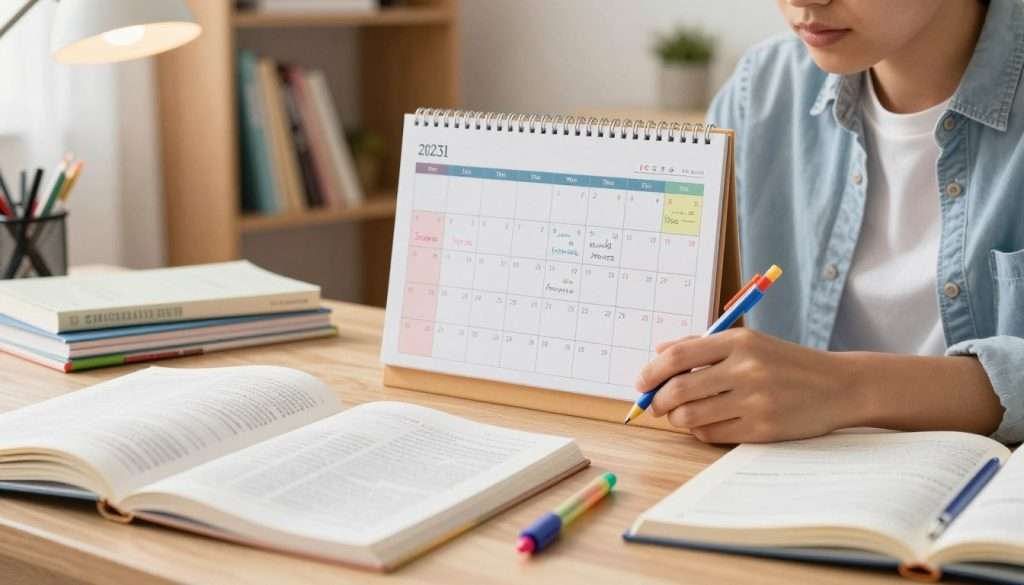
Write down each class, its credit hours, and the work already on your calendar. The University of Illinois shares the weekly study-time guideline and a calculator to help students plan their commitments.
Thirty minutes per class on each of 6 days adds up to 3 hours per class per week. That small daily block can be easier to protect than one long session squeezed between errands, work, and class.
Turn the weekly estimate into a realistic calendar
Use this quick planning list to turn a rough estimate into time you can actually keep:
- Write down each class and its credit hours.
- Mark exam dates and difficult topics.
- Assign short sessions to days you realistically have available.
Students balancing a job, family tasks, or a long commute may have very different open hours. A weekly calendar helps you see those limits before you promise yourself study time that does not exist. You can also compare busy days with lighter ones and place extra practice where it fits.
Put the hardest or soonest-due class into your calendar first, while your available time is still visible.
When Is the Best Time of Day to Study?
The best study time is usually the part of the day when you feel most alert and can think clearly. Your chronotype is your natural timing preference, such as feeling sharper early or later in the day. Schedule demanding work when your attention feels steady.
Notice when focused reading or problem-solving feels easiest for you. One student may handle a tough math set before class, while another needs a quiet afternoon before the steps click. Your own pattern matters more than copying a friend’s schedule.
Match your study time to your chronotype
A 2023 review found that cognitive performance varies with time of day and chronotype. People generally perform better at their preferred time of day, though the task and the person both matter.
For a few days, note when you begin work and how well you hold your focus. A quick check after reading or solving problems can show whether that hour suits deep thinking or simple review. Look for a pattern, not one unusually good or bad day.
Use the day’s natural alertness shifts wisely
Alertness generally rises during the day, dips briefly in the early afternoon, and peaks in the late afternoon. That broad pattern offers a useful clue, but it does not overrule your own timing preference.
The risk of errors can rise at night and in the early morning, with some effects tied to chronotype. If you are choosing between hard new material and an easier task during a low-energy hour, save the tougher work for a clearer period.
Track your focus for a few days and schedule the toughest work in the hours when your attention holds steady.
How Do You Build a Focused Study Session?
A focused session works best when you choose one clear outcome, set a timer, and remove the easiest distractions. One job gives your attention somewhere to land, whether you need to learn terms or solve a set of problems. Finish with a quick check that makes you retrieve what you learned.
The Pomodoro Technique uses 25 minutes of focused work followed by a 5-minute break. After four blocks, take a longer break of 15-30 minutes. Another option is an intensive 30- or 45-minute study session, then a pause that fits your needs.

Choose a block and a real break
There is no prize for picking the longest timer. A shorter block may suit flashcards, while a 45-minute stretch may fit a complex problem set. Try one format for a few sessions and notice when your work starts to slow.
The Study Cycle, developed by Frank Christ, has five stages: preview, attend class, review, study, and check understanding. A 10-minute review of notes on the same day as class is a practical way to reinforce them before details blur.
Make your space support the task
Set up the space before the timer starts. Gather the pages, calculator, and other materials you need, then make your phone harder to reach. Quiet may help you read closely, while light background noise may suit routine tasks.
Use this checklist to start and finish each session with less fuss:
- Choose one specific outcome.
- Gather the needed notes and materials.
- Silence or move the phone.
- Set a timer.
- Finish with a quick retrieval check.
If you cannot explain what you learned at the end, shrink the next session’s goal until you can.
Should You Study When You’re Exhausted?
If you are too exhausted to retrieve or understand anything, rest is a better next move than another marathon session. Take a restorative break or sleep instead of forcing work that is no longer sticking. When the deadline is close, choose a short, easy review if you can still think clearly.
Healthy adults are generally recommended to get 7-9 hours of sleep, though individual needs vary. An all-nighter is a poor trade: it can impair thinking, alertness, judgment, and decision-making, with focus effects that may last a week.
Decide whether you need a reset or a lighter task
Check what your mind can still do. If you can explain familiar ideas but cannot face a new chapter, review a few key terms instead. If even simple questions feel impossible, stop and give yourself time to recover.
Keep the lighter task small and familiar, such as recalling a few class concepts without opening a new topic. That way, a close deadline does not trick you into spending a long stretch staring at words that will not stick.
Skip the all-nighter and protect your sleep
A 2025 study followed 33 university students for 14 consecutive days using actigraphy, a device-based way to track sleep. Higher exam scores were associated with greater sleep efficiency, shorter sleep-onset latency, and less night-to-night variation in those measures and total sleep time.
The 2025 sleep study found those exam-score associations especially pronounced on weekdays. These were associations, not proof that sleep patterns caused higher scores. Still, losing a full night can leave you less able to think clearly when an exam asks you to use what you know.
An all-nighter can impair judgment and decision-making, and its effects on focus may last up to a week.
Protect the sleep you need before an exam instead of trading it for one more unfocused hour.
Conclusion
Better study habits grow from small choices you can repeat, not one perfect week. Pick one class, set a clear goal, and try a study session that asks you to use what you remember.
Keep building your skills with my free book, How to Become the Smartest Student in the Classroom. It offers memory techniques, study routines, and strategies that stick.
If this article resonated with you, my free book How to Become the Smartest Student in the Classroom gives you a full system with memory techniques, study routines, and strategies that actually stick. No cost, no catch. Grab your free copy here → https://www.studyingmachine.com/free-books/.