

A strong study playlist is usually low-volume instrumental music matched to your task, with silence as a smart choice for reading-heavy work. Instrumental music means music without lyrics. The best choice is the one that helps you focus without tugging your attention away.
Some days, a soft beat makes it easier to settle in. Other days, even a favorite song can crowd your thoughts during reading tasks. We’ll help you pick a sound that fits your work and test whether it supports your study habits. There’s no prize for sticking with sound that distracts you.
Key Takeaways
- Try quiet instrumentals for a low-distraction start.
- Choose silence when reading takes full attention.
- Match sound to the task, not the mood alone.
- Compare focus and recall, not just enjoyment.
- Treat the first playlist as an experiment.
Treat the first playlist as an experiment, not a rule you have to follow.
Does music actually help you focus?
For reading and word-heavy tasks, silence or lyric-free sound is a safer starting point than songs with lyrics. Music with lyrics can hinder memory and reading, while instrumental music showed no clear effect.
Lyrics can compete with reading and memory
A college-student study compared silence, instrumental hip-hop lo-fi, and music with lyrics. The groups ranged from 113 to 123 students. The verbal, visual, and reading results showed that songs with lyrics hindered those tasks by a modest amount.
The cognitive-task study found no credible arithmetic effect from songs with lyrics. That result does not mean every listener reacts alike. Your energy, task, and familiarity with a song can shape how it feels.
Treat background sound as a trial, not a promise of better scores.
The study measured task performance, not whether music felt pleasant or helped students settle in. Music can feel comforting without improving a quiz result. Keep that difference in mind when you judge your own study focus.
Instrumentals are a low-distraction test
Instrumental hip-hop lo-fi did not credibly improve or harm performance in the study. It can still make a quiet room feel less stark. Use it as a test, not a guaranteed memory boost.
The best study playlist for most reading-heavy work is lyric-free, though silence may suit close reading better. A preferred song can also help some students report less mind-wandering. Reported focus and measured accuracy are different things.
If you notice yourself following the words instead of the page, switch to silence.
https://www.youtube.com/watch?v=ZrKPW5d3idY
Build a Study Playlist for Each Kind of Work
For close reading, try silence first; for a writing session, start with a quiet instrumental soundtrack. Match the sound to the task, then compare how well you work.

| Study task | Starting sound | Example |
|---|---|---|
| Reading or comprehension | Silence or subtle background sound | Soft room noise |
| Essays or creative writing | Film scores, lo-fi beats, or soft jazz | Quiet instrumental soundtrack |
| Math or coding | Silence or moderate-tempo instrumental music | Steady piano music |
| Formulas or vocabulary | Try upbeat music; reuse it during review | The same playlist each time |
A free study playlist can use music or ambient sounds you already have access to. A funny study playlist or a study playlist with R&B may suit a break or lighter task better than close reading, especially when lyrics catch your attention.
Keep volume low and skip songs that invite you to sing along. One sustained-attention study tested 40 students with silence and preferred music. Students reported better task focus with preferred music, but reaction time did not significantly improve.
Try music, silence, and white or brown noise across one week. Track quiz or self-check results, comfort, and focus time in a simple note. A 40-45-minute session gives each sound room to settle before you compare results.
Keep the volume low enough that the sound stays in the background.
Which Spotify playlists and songs should you try?
For focused listening, try Instrumental Study or Deep Focus first, then choose a moodier option if you need a softer backdrop. A popular playlist is not automatically a good fit for studying.
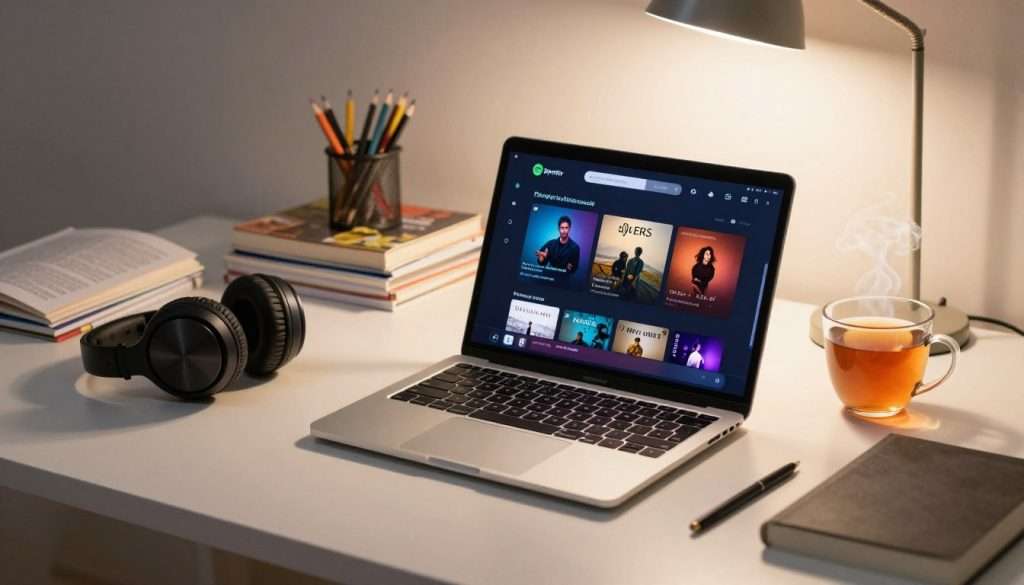
Spotify playlists for different moods
Instrumental Study and Deep Focus offer lyric-free options for concentrated work. Brain Food and Jazz in the Background can suit a different mood. Try a few tracks before settling in; a catchy chorus can turn your notes into a sing-along.
Spotify’s 2026 most-followed-playlist ranking began with Today’s Top Hits at 34.2 million followers, followed by Top 50 – Global at 17.0 million and RapCaviar at 15.7 million.
Viva Latino ranked fourth with 15.4 million, All Out 2010s fifth with 14.8 million, and Rock Classics sixth with 13.0 million followers.
A playlist’s follower count measures popularity, not how well its tracks fit your work.
All Out 2000s ranked seventh with 12.9 million followers, All Out 80s eighth with 11.9 million, and phonk ninth with 11.7 million.
Songs to Sing in the Car took tenth place with 11.2 million followers. Those rankings reflect broad listening tastes, not a study scorecard.
A 2026 U.S. survey found that 44% of people ages 18-25 chose Hip-Hop as their favorite genre. Another 22% listened to multiple genres depending on mood. Among listeners under 30, 90% enjoyed pop, 83% hip-hop or rap, and 75% R&B. Those figures describe preferences in those groups, not one universal Gen Z favorite.
Song ideas and listening settings
Try these five songs as possible additions, then notice whether each one keeps your attention on the task:
- “ID” by Kygo
- “Found Again” by Don Phillipe
- “Snowcone” by deadmau5
- “Stuff We Did” by Michael Giacchino
- “I’m Forrest… Forrest Gump” by Alan Silvestri
Spotify’s 2026 all-time global streaming ranking placed “Blinding Lights” by The Weeknd first. A high stream count says little about whether a song suits your next reading session.
You can listen to a study playlist on Spotify or YouTube. Spotify Premium lets you download albums, playlists, and podcasts for offline listening. Free users can download podcasts, but not music.
To download a study playlist with one specific song, add that song to a playlist and download the playlist. Spotify does not offer individual-song downloads. Premium users can keep up to 10,000 downloaded tracks on each of five devices.
Those downloads need an online connection at least once every 30 days to stay available. Spotify’s offline download limits also apply when you switch devices or save more tracks.
In the United States, Spotify’s terms updated September 4, 2026, set the minimum age at 18, or 13 with parental or guardian consent. The explicit-content setting can gray out, block, and skip tagged tracks. A Spotify Premium Family plan manager can allow or block explicit content for other members.
Spotify Wrapped requires an account and a few hours of listening. If you’re building study routines over several days, keep your focus choices separate from your listening recap.
Before downloading a playlist for a trip, check that your device has gone online within the past 30 days.
Conclusion
Start with one sound choice that suits your next task, then keep the option that helps you focus. Check real work, not just how comfortable the music feels. A quick self-check after studying can show whether you recall the key ideas.
For more ways to build effective learning habits, get the free book, How to Become the Smartest Student in the Classroom. It offers memory techniques, study routines, and strategies that stick. It has no cost and no catch.
Grab your free copy here: https://www.studyingmachine.com/free-books/.